Sunday, October 5, 2014

New Students, New Plants, New Garden!

The Green LIONS Garden Group officially kicked off its 2014-2015 school year on September 24. While we planned to plant our fall garden on that day, a Nor'easter had other plans. So like plants that can acclimate to changing weather, we moved on to Plan B.

At our first meeting we learned about the different parts of plants we eat; roots, stems, leaves, fruit, seeds, and flowers. We explored different familiar plants and determined what part it is that we commonly eat. Did you know that a broccoli floret is actually the plant’s flower? We also looked at how these different parts of the plants contribute to the plant’s health and well-being.


The roots keep a plant in place and also store some of its food for later use. The stem helps to move water and nutrients from the soil up into the plant out to its leaves. It also helps to move sugars from the leaves, created during photosynthesis, to other parts of the plant. The leaves aid in photosynthesis absorbing light energy from the sun and carbon dioxide from the air to create its own food, and give off oxygen as a waste product. The flowers help to create either the fruit that contains the seeds to make future plants, or the seeds themselves to help produce more of the same plant. The flowers are also perfectly designed to attract pollinators to them to help create the fruit.

Students learned how plants are a major part of most food chains. Because a plant makes its own food, it is called a producer. Insects, other bugs, and all animals are consumers because we can’t make our own food. Students divided up into groups and each played the role of either a plant (producer), insect (consumer) or animal (consumer). Students in each group then had to place themselves in order from the smallest to largest in their food chain.

Food chains lend themselves to food webs and symbiosis, a relationship in which both parties or multiple parties help provide what is needed to allow the other party or parties to thrive. While animals eat plants we also help to spread the plant’s seeds. While plants give off oxygen that we breath, we breath out the carbon dioxide that the plant needs to make sugar for its food. Animals also eat other animals and insects. Through a not so successful yarn web experiment (yarn malfunction) we were able to see that if there were no plants, there would be no insects, then there would be no hon-human animals, and finally no humans. But if there were no humans, animals would still thrive and if there were no animals it is reasonable to think that insects and plants could survive. We concluded that we need plants more than plants need us providing yet another strong argument for why we need to take care of our planet.

So on Wednesday, October 1, our second meeting, the sun was shining! Farmer John from New Earth Farm came out to help the students plant our fall garden. We planted lettuce, cabbage, green onions, mizuna, bok choy, tatsoi, arugula, kale, herbs and garlic. We have a handicap-accessible garden table in the garden area and our youngest program participants (the children of our parent representatives) planted a special selection of plants in it. It is the LIONS table in the LIONS garden. Thy planted Lettuce, Italian flat-leaf parsley, Oregano, Nasturtium seeds, and Sage spelling out the word LIONS. The LIONS in our LIONS Garden name represents Local, Indigenous, Organic, Nutritious, Sustainable.


Come visit the LIONS Garden and see our beautiful fall plants carefully planted by our newest gardeners!

Sunday, May 4, 2014

Bees, Trees, and Salve Please!

The Green LIONS Garden Group welcomed Tidewater Beekeepers Guild member and beekeeper Barbara Hickey to our meeting two weeks ago. Ms. Hickey engaged students with tales of her beekeeping hobby and a vast collection of gear, photos, and teaching aids to observe.


Ms. Hickey is not the only beekeeper in her family. Her husband and two sons also work with their hives. She brought a beekeeper’s mask and suit that belongs to her nine year-old son. And she told of how her older son used a bee’s perspective to complete a report on a chicken sandwich! He connected the food that is fed to the chickens to plants that are pollinated by bees and even the pickle you may find on a chicken sandwich. Now that is creativity at work.

This connection reminded the students of how one of out of every three items on the average plate would not exist without bees and their pollination. Ms. Hickey spoke with the students about what we can do to help protect the bees in the ongoing and unsolved battle against colony collapse disorder; like not using chemicals on our lawns or vegetable gardens and supporting food growers who also do not use chemicals. She was pleased to hear how many students knew ways to help protect the bees in their daily environmentally-friendly choices.


Ms. Hickey even brought a display of live bees at work in a screen from a hive. It was amazing to see the bees up close and hard at work. After enjoying a thorough and very interesting explanation of how bees produce honey and how humans extract it from the hives, students enjoyed a sampling of honey-sweetened lemonade. We have included the recipe here.

Honey-Sweetened Lemonade

4 cups water
1 cup honey
1/2 cup freshly squeezed lemon juice (hopefully from organic lemons!)

Mix 1 cup water and honey together in a pot on the stove-top until melted. Mix with the remaining water and lemon juice in a pitcher or jar and refrigerate until cool.

Students then went outside to tend to their newly planted seedlings by watering and weeding the garden beds. Now when they see bees peacefully buzzing through the garden they can smile at their fellow garden workers.


Last week’s meeting brought horticulturalist Michael Bender of McDonald Garden Center to speak of trees and bushes we can enjoy in our own yards or communities. He introduced the students to many different varieties of berry bushes and fruit trees. He spoke of such varieties as the Urban Apple Tree that while growing to be 8 feet tall only grows 2 feet wide, making it perfect for small urban yards. He showed varieties of raspberry, blueberry and juneberry bushes that only grow 2-3 feet tall and equally as wide, fitting into small spaces. He spoke of how the native PawPaw tree, one of which we just recently planted, tastes like Banana Custard Pie. We’re excited to try that one!


All of the bush and tree varieties made the students excited to begin growing some of their own fruit in their own yards, the beginnings of their own permaculture at home.

After Mr. Bender finished his presentation we completed our bee study with a craft using beeswax. We melted down beeswax, coconut oil and olive oil and then the students added Vitamin E oil and essential oils of rosemary, tea tree, and lavender to create a homemade garden hand salve. Gardening, while great for our bodies, can be rough on our hands so this salve helps replenish lost oils and smooths out roughness. Students can keep the salve for themselves or gift it to an adored woman in their life this coming weekend on her special day, wink wink.


Sunday, April 20, 2014

Spring Means Dirty Hands

“In the spring, at the end of the day, you should smell like dirt.”—Margaret Atwood

The Green LIONS Garden Group has been busy in the LIONS Garden preparing the soil, weeding what doesn’t belong and planting good things to eat in a couple of months. Farmer John came to both our planting meetings to pass on his wealth of knowledge and guidance to the students.


We spent two meetings planting; one week planting our “direct sow” crops, and the other planting our seedlings. Direct sow crops are plants that require their seeds to be planted directly in the garden soil. Seedlings are plants that do better being gently nurtured to a small size inside or in a greenhouse, then transplanted into the garden. There are some plants that do equally well planted either by seed or by seedlings, like kale and lettuces. We chose to plant seedlings of these plants in the LIONS Garden because our spring growing season is shortened by the school year’s end.


Our direct sow crops included radishes, carrots, beets, turnips and sugar snap peas. We also planted seed potatoes, essentially pieces of sprouted old potatoes, which will grow into potato plants with about 30 potatoes each! GLGG parent representative Dave Rooks built our beautiful new trellises that our sugar snap peas will climb. Students were asked to pay close attention to spacing and depth instructions for each crop to make sure they will grow properly. They also were reminded to consider the height of each plant’s growth to stagger the plants where they would not be shaded by a taller neighbor.


At our next meeting we planted our seedlings which included, lettuces, kale, tatsoi, arugula, scallions and spinach. Students had to determine how many of each plant could fit in a square foot and lay the plants out in a eye-pleasing design. They also were encouraged to consider companion planting rules to make sure plants were planted with growth-encouraging partners.


Farmer John helped the students thin out our overgrown strawberries, transplanting those removed into other spaces in the garden bed. We hope to fill one whole bed with plants of this delicious fruit. And thanks to our partnering girl scout troop we now also have three fruit trees to add to our fruit bounty; a persimmon, peach and native paw-paw.


Now we let nutrient-rich soil, gentle spring rain, and sparkling sunshine do its magic.


Monday, March 24, 2014

Permaculture is Our Very Near Future

Students of the Green LIONS Garden Group have been studying all the partners of a thriving garden. First we explored the importance of pollinators and how we can protect them through our actions and choices. Second we learned about permaculture and how we can expand our gardens and yards to include habitats for pollinators, birds and collected rainwater.

Two meetings ago we watch scenes from The Vanishing of the Bees, a documentary on the phenomenon of Colony Collapse Disorder or CCD. CCD is diagnosed when a colony abandons a hive for no obvious reason leaving behind the queen and some young bees. This disorder has been studied thoroughly and many suspected causes, like cell phones, mites, bacteria, and satellite transmissions have been discredited. The current and most likely cause is the widespread use of systemic pesticides.


Years ago pesticides were mostly applied via spraying by hand or airplane dusting. This sent harmful chemicals into the air where it affected health of wildlife and humans. To remedy this, systemic pesticides were developed where the pesticide is applied to the seed usually along with a coloring agent and when the seed is planted, the pesticide grows inside the plant. While this cuts back of airborne chemicals, the pesticide is still in the pollen and nectar of the flowers of the plants. Bees and other pollinators collect this polluted pollen and nectar and take it back to the hive. The cumulative effect of these chemicals in the hive damages the immune and reproductive systems of the bees making them more vulnerable and susceptible to mites, bacteria and other harmful pathogens. It is also suspected that it mutates the eggs causing the bees to be born with unnatural characteristics that cause the hive to abandon them and move on.

Students learned that there are many ways we can help protect honeybees and other pollinators. We can stop using harmful chemicals on our lawns and in our homes. We can support growers and producers using organic methods and shop at local farmers markets. We can also plant habitats in our yard to attract pollinators.

In planting a habitat like a pollinator garden, we are expanding our yards and green spaces using the concept of permaculture. Permaculture is the system of growing our own food with ecological design that works with people, our natural environment and ecosystems. This system provides positive solutions to environmental problems we see today like the pollution of our air, soil and water through emissions. Through this system, families can learn to grow their own food, collect rainwater, produce their own energy and design their home to be always comfortable without excess use of heating and cooling. Families can start small, by simply replacing many of the ornamental plants in their yards with berry bushes, fruit trees, butterfly gardens, rain gardens and more. Growing plants, bushes and trees that work together contributes to self-sufficiency while contributing positively to the community and planet as a whole.

Master Naturalist and permaculture designer Ashley Grosch visited our last meeting to talk with the students about her work. She explained how permaculture is guided by a set of three ethics: care for the earth, care for people, and fair share. She told the kids about how she started gardening when she was only eight years old. She found a sprouted potato in the cupboard and planted it. Once she saw how we can turn something considered trash into a growing plant and ultimately food, she was hooked. Today, Ashley designs beautiful gardens and permaculture areas for families and businesses.


Ashley also shared her vermi-composting system with the students. Several trays stack on top of one another showing each stage of the decomposition process from fresh food scraps to finished compost ready for the garden. Practices like composting are integral in a permaculture system where human practices work along and in harmony with nature-driven processes.

Our own LIONS Garden is a miniature permaculture. We have edible beds right along butterfly bushes, flowering plants, a rain barrel and compost bin. We also are adding a small orchard this spring.


Monday, March 3, 2014

Incredible Edibles

The Green LIONS Garden Group had a welcome visit from Whole Foods Market at our last meeting. We have a strong connection with the Whole Foods company because The Whole Kids Foundation, one of Whole Foods’ organizations, generously awarded us a grant to fund our school garden and garden program for this school year. So having nutritionist Cara Blume from Whole Foods Market visit was such a special treat for many reasons. She was able to see our program at work and also give the students a wonderful lesson in healthy living.

Ms. Blume brought hummus and pita bread along with fresh vegetables and fruits. The students were encouraged to make edible art with the foods items using skewers, hummus “glue” and heaps of creativity. Their creations were as impressive as they were delicious.


Ms. Blume also brought along Ann Marie the Sprout Lady. A former elementary school teacher, 
Ann Marie entertained the students with a quick lesson on and tasting of micro-greens, showing how easy they are to grow, and explaining their nutrient-dense benefit. She then allowed each student to choose to grow either pea sprouts or sunflower sprouts for a take-home micro-green mini-garden. After only a few days of simple watering there were delicious sprouts to nosh on. 
What could be easier?!


The visit of both Ms. Blume and The Sprout Lady brought a little sunshine into our February with the taste of all the fresh Spring vegetables and outdoor fun soon to come.


Monday, February 17, 2014

The Answer to a Growing Problem

How does nature provide us with food?

How does food get from where it is grown or raised to where we buy it?

What was the last thing you ate and from where did it come? If it was a packaged food and there were many ingredients listed, from where did they all come?

Has your food traveled to more countries than you have?

While our global food system provides variety, it also has a major impact on our environment. We are also becoming removed from our food sources. What is the answer to this growing problem?

These are just some of the questions the Green LIONS Garden Group explored at our last meeting. We explored how the food that nature provides for us is delivered to our plates. We learned the definition of carbon footprint and discussed how food that travels many miles to our community stores contributes to this footprint for each individual. With most food traveling an average of 1500 miles to where we buy it, 20% of the average American’s carbon emission output is due to our food buying choices.

How can we positively affect this growing problem of food transportation on an individual level? The answer is buying locally grown food when it is season. Is this an all or nothing suggestion? Absolutely not. But if the average family spent even $10 a week on produce or other food products grown or produced locally it would have such an amazing impact on not only our local economy, but our own health and the health of our communities.

Students learned of how scarce the land is to even grow food on our planet. We used an apple as an example to represent the earth. After cutting it into four pieces we explained that 3 parts of the four are covered with water. The remaining fourth we cut in half again and explained that one of these parts is covered with land that is too mountainous, cold, dry, wet, or otherwise unsuitable for growing food. One eighth of our planet is now left and we then sliced this into four slices. Three of these slices are already covered by cities and highways. The one tiny piece remaining represented the remaining land available to grow food and clothing for billions of people. This exercise emphasizes the importance of taking care of our land, and at a closer level how we can properly steward our own piece of land at school where we produce food.


Exercises like the one above helps students see how important their food choice decisions are to keeping our planet healthy and to guard the small amount left on which to grow food. By supporting our local producers and eating seasonally we can do just that.

We used another game to express how many steps are taken in producing a food product. Scenario number one: We want to make a pizza and have a crust but no pizza sauce. What do we do? We used a ball of yarn and 24 steps to show how a jar of pizza sauce comes into our kitchen, including growing and processing the tomatoes, the herbs used in the sauce, the cans for the processed tomatoes, the jars used for bottling the sauce, the journey to the grocery store, etc. Each student held a step and a corner of yarn to create a large web of steps on the pizza sauce’s journey. Scenario number two: We go into our own garden in the summer and pick tomatoes and herbs, or go to a farmer’s market in the summer to gather these ingredients, or into our own pantry or freezer where we have canned or frozen local summer tomatoes to make our sauce. The students holding the now needless steps in the pizza sauce journey let go of their corners and the web was visibly much smaller with only about a third of the steps remaining. This represented the lessening impact on our environment when we choose local and seasonal produce.


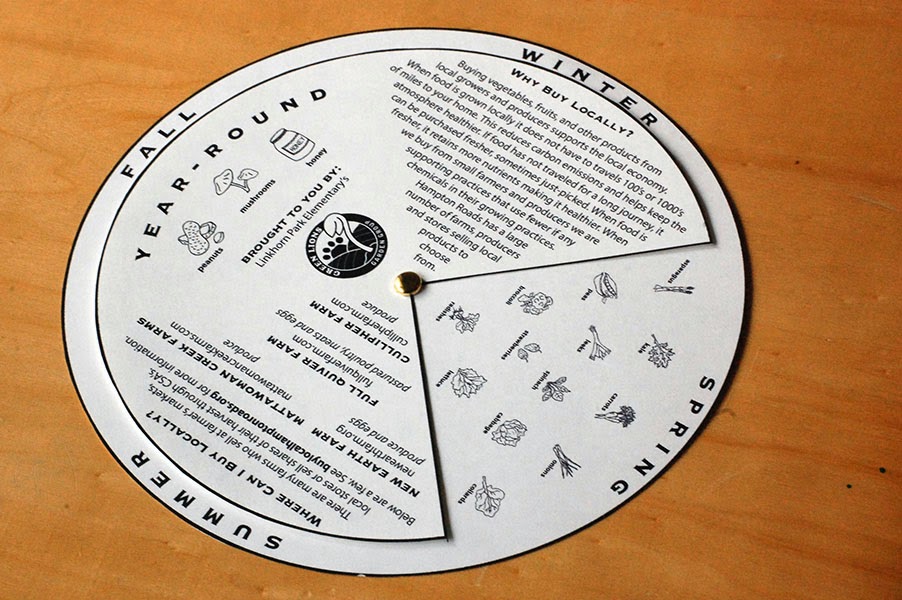
Students took away a thought-provoking and empowering lesson on how they can choose to make a difference in the health of their own community by encouraging their families to eat locally and seasonally from the many stores, markets and farms carrying food products here in Hampton Roads. They were also able to take home their own tool to learn which produce grows when in our area, our program’s own Local and Seasonal Food Wheel, so they can find their favorite fruits and vegetables when they are growing and available. Small steps make huge impacts. Happy Eating!