Monday, April 25, 2016

Seeds, Soil and Sunshine


Spring is here in all of its glory and so begins the gardening season. To prepare our own spring garden students strategically planted seeds, dug small holes to drop in infant seedlings, and learned all about the soil in which we are growing our garden. With water, sunshine and careful nurturing, our spring garden will grow steadily and provide a bountiful harvest in just a few short months.

Students learned the difference between planting by seed, which is called direct sowing, and planting seedlings that have had a head start in a greenhouse. They learned which plants like to be directly sown and which like to be transplanted from a small container to the garden bed. Some plants are very particular to their planting method, and some are flexible and can successfully grow from either seed or transplant. Leafy greens are examples of flexible plants, and root vegetables are examples of plants that must by directly sown.

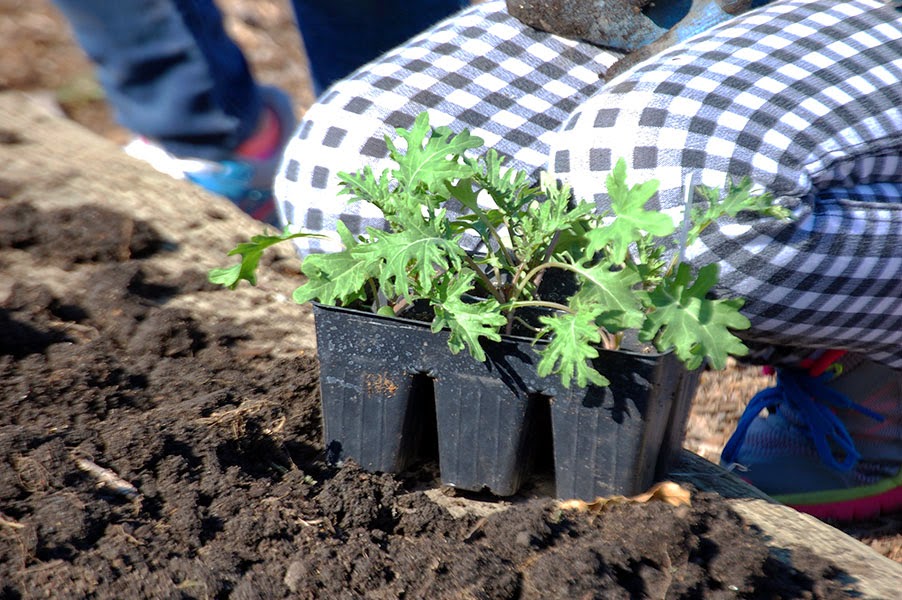
Students planted root vegetables at one meeting which included radishes, carrots, sugar snap peas, turnips, and beets. At the following meeting students planted leafy greens, herbs and flowers including lettuce, kale, chard, arugula, onions, tatsoi, spinach, and nasturtiums. Farmer John Wilson from New Earth Farm, our consistent mentor and farming consultant, came out to plant with the students and tell him all about his chemical-free and sustainable farm. Farmer John’s visits are always highly anticipated, fun and educational.


The quality of our garden plants depends heavily on the quality of our soil. Healthy soil equals healthy plants. We are fortunate to be able to acquire nutrient-rich compost from New Earth Farm to amend our soil each spring to give our plants a huge energy boost. Students received a basic understanding of the mini eco-system that makes up our soil—like microbes, insects and other organisms—and gained an appreciation for the delicate balance of nutrients the plants need. While they now know that it takes time to develop this healthy soil balance, we can help our soil along the way by adding nourishing amendments like compost.

Students learned about vermi-composting and how to set up a worm bin. Worm bins are great ways
to turn trash into treasure and a sustainable way to dispose of our food scraps, instead of having them rot in a landfill releasing methane gas. Worm castings make an excellent compost for a
chemical-free garden.


The importance of water and proper irrigation for a healthy garden was also covered at our Green LIONS Garden Group meeting. We are fortunate to have a drip irrigation system in our garden. While using city water is not the most sustainable way to water, a drip irrigation system allows our garden to be watered regularly since it is in a school setting and not, for example, at someone’s home where they could easily water whenever it is convenient. A drip irrigation system is more eco-friendly and efficient than say a sprinkler system, because the water drips slowly and there is a 90% absorption rate instead of high evaporation.


Students learned about how we also collect water in our rain barrel and they are able to use watering cans with collected water to water the garden at our meetings.
Did you know that 3o% of water used in our urban area is used to water lawns and gardens? 
Did you also know that 35% of municipal electricity is used to treat that water?
Collecting water through rain barrels or using well water is a much more sustainable way to grow healthy lawns and gardens without depleting our natural resources. Of course, rain is the best irrigation of all! And if we received one inch of rain in a week we should not have to water established vegetable and fruit plants at all. Now that would be convenient.


Monday, March 21, 2016

Plants Rule the Planet

The Green LIONS Garden Group explored the concept of photosynthesis at our last gathering. Students took on the roles of plants, water, carbon dioxide, sugar, light energy, and oxygen to perform a creative skit for our teacher volunteers. The skit helped students to understand the vital role plants play in our survival and the survival of the planet. Through converting light energy from the sun, carbon dioxide from the air and water absorbed through their roots to sugar energy, plants then release oxygen to our benefit and the benefit of all living beings. Because plants can make their own food, they are producers and self-sufficient in optimal conditions.

Once photosynthesis was clearly grasped students and plants placed on their rightful throne, students shaped themselves into a food chain pyramid. Plants represented the largest group, then insects, then small animals and birds, then larger animals, and finally a lone human at the pyramid’s top. The question was then posed to the students, “what if there were no plants?”


If there were no plants then the insects would have nothing to eat and they would die off. If there were no plants and insects, small animals and birds would have nothing to eat and they would die off. If there were no plants, insects, birds and small animals, then larger animals would have nothing to eat and would die off. If there were no plants, insects, birds, small or large animals, then humans would have no food and would go extinct.

However, if we reverse this hierarchy what would the results be? What if there were no humans, then large animals, then birds and small animals, and finally no insects. Plants would thrive! They don’t need us, but we are completely dependent on them. Plants rule the planet!

We then just had to take advantage of our ten pin bowling shape to do a little human bowling!


To end our gathering, Sustainable Student Ambassador Cassie Carbonneau’s mother Mindy, an environmental science teacher in our school system, brought two cute and fuzzy members of the food chain for the other Sustainable Student Ambassadors to ooh and ahh over. The little chicks pecked at the grass exhibiting their taste for plants and insects in a food chain. If chicks are involved...then spring has sprung!


Monday, March 14, 2016

Try This Green Thing at Home

A new feature we are unveiling for the participants in the Green LIONS Garden Group and their families is our Try This Green Thing at Home eco-friendly challenge.

This week we are challenging our families to Switch to Cloth Napkins!


Making this change is a simple and enjoyable sustainable act. Using cloth napkins makes any meal, even a school lunch from your lunch box, seem like a fancy one. Buying or making napkins with patterns can easily hide stains. Linen is a more environmentally-friendly choice over cotton but even cotton is better than paper.

It is estimated that 28% of all trash is made up of paper products. The U.S. uses more than 160 billion paper napkins annually. This adds up to 4 billion pounds of paper waste.

Have fun with your napkin print choices. Allow your children to choose napkins with favorite characters or themes. If the napkins aren’t dirtied by an especially messy meal, then allow them to be used more than once. Perhaps assign a special napkin ring to each family member to keep the napkins separate and available. Switching to cotton napkins easily saves a family money and teaches a sustainable practice they can feel good about.


Saturday, March 12, 2016

Plant Anatomy 101

The Green LIONS Garden Group kicked off their spring program with their first meeting of the year last week. With surprisingly spring-like weather outside we could all envision our spring garden and the veggie goodness to come. If we plan to grow plants, first we need to learn a bit about them, especially their anatomy.


From roots to fruit, students learned all six anatomical areas of edible plants—roots, stems, leaves, flowers, fruits and seeds. Each plant is unique in how they present these parts and whether these parts are edible on a particular plant.

Did you know an eggplant is really just a big berry? And in plant anatomical terms, did you know broccoli florets are considered flowers, and a bell pepper would be considered a fruit? A fruit is the part of the plant that surrounds its seeds. So many of the vegetables we commonly eat are actually the fruit of the plant. Maybe calling them “fruit” can help us convince kids to eat more vegetables!


Students enjoyed a Plant Anatomy Relay Race in the warm air. They divided into three groups and chose plants from a grab bag that they had to both identify and determine its anatomical part categories before returning to their group. Each bag had a tricky choice but students quickly categorized their veggie bag contents into their correct anatomical parts.


Next, we toured the garden to see the last of the over-wintering plants and the perennials that are awaiting their spring awakening. Spying a large patch of chickweed some students grabbed handfuls to take home to start their olive oil infusion for making bug bite balm—a GLGG favorite. See the recipe in our last post.

We are excited to embark onour program for this school year, with new students and some club veterans. We can look forward to dirty hands, nourished bellies, sun-kissed cheeks and a full toolbox of strategies to live in harmony with nature.

Monday, May 4, 2015

Conservation Conversation for 20 Please

Students of the Green LIONS Garden Group were game show contestants at our last meeting; contestants of Garden Jeopardy that is. Our categories were Down on the Farm, Conservation Conversation, Garden Friends, and Plant Rant. The winning team now receives the prestigious honor of being first in line at the Harvest Tasting!


And what will be served at the Harvest Tasting later this month? Just take a look.


Chemical-Free Garden, Chemical-Free Us

One of the greatest lessons we teach to the students of the Green LIONS Garden Group is how to grow plants without the use of harmful chemicals. By diligently monitoring the presence of pests and the balance of beneficial predator insects, and by strengthening our plants with natural fertilizers like compost and companion plants students understand that there is no need to take the short-cut, chemical route. Nature takes care of you if you take care of it.

So as we move into mosquito season, we thought this would be a great time to translate the care of the garden to the care of our bodies. If we take care of our health, our bodies will take care of us.

Many body care products are full of harmful chemicals. While a little of this and a little of that can be benign in small doses, in the end most people use a little of a lot of different things which can add up in a hurry. If you are interested in determining if your favorite products are safe for you and safe for the earth, you can visit ewg.com. This site is a vast database of information on products we use on our body, in our body, in our home and more.

Students were apothecaries for a day by making their own bug repellant spray and (if that doesn’t work) bug bite balm to take the itch and sting away and expedite healing.

The two recipes couldn’t be simpler and we have provided them below. Consider looking into what other body care products and cleaning supplies you can make on your own. There are multiple sites with recipes and you’ll soon see how easy and economical it can be. Enjoy!

Herbal Bug Repellant Spray

Fill a pump bottle (we used 2 oz. amber glass spray bottles, but you can go bigger) half way with distilled water. Fill the remainder of the bottle almost full with witch hazel, leaving a little room for essential oils.

For our 2 oz. bottles we used three drops each citronella, rosemary, lavender and cinnamon essential oils. For a larger bottle you can add more. You may also want to try other oils like eucalyptus or lemon.


Patience: One of Nature’s Greatest Lessons

In a world where we are used to instant gratification, it can be nice to know that some things are worth waiting for. Even if we have to wait three years for that first bite.

We planted asparagus in our spring garden this year. Asparagus is an interesting plant. Traditionally once it is planted it needs to grow through two full springs untouched. Then in that third spring the delicate spears can be harvested. While its growing season each spring is short, asparagus is a perennial, and will give back to us year after year.

Patience is one of many lessons students can experience first hand in a garden. Students also learn kindness, how to be gentle, how to nurture and to take in their world with all of their senses. Learning how to respect and care for plants goes beyond the garden beds. This devotion is translated to their community and the world at large and changes they way they interact with their environment.

While asparagus is our exciting new addition to the garden this year, students of the Green LIONS Garden Group planted many of our favorite spring plants: tender lettuces and spinach, spicy arugula, spunky radishes, vibrant purple carrots (the most nutritious variety for us by the way!), humble turnips, robust beats, crunchy sugar snap peas, elegant nasturtiums, dependable kale, and hearty cabbage and broccoli. We also spruced up the herb bed with new plantings of cilantro, dill, parsley and sage. Our borage flowers, avid self seeders, are coming back from last season, as are our strawberries. The blueberry bushes are trying hard to rally, and while our fruit orchard lost its native Paw Paw, the plum and peach trees have leaves and will soon have flowers.


Students enlisted the help of our worm bin by harvesting castings to add as natural fertilizer to boost the soil for planting. It takes a community of organisms, bacteria and a little human help to grow delicious vegetables in harmony with the earth.

This year we dedicated a portion of a garden bed to Thomas Jefferson by planting some of his heirloom seeds from Monticello. Jefferson was an influential seed saver and a lifelong student of nature. I wonder if he could have predicted that students today would enjoy planting seeds from the same plants in his vast garden. Tradition and sustainability, two more lessons taught by our garden.

“No occupation is so delightful to me
as the culture of the earth, and no
culture comparable to that of the garden.”—Thomas Jefferson